

Why Kids Get Angry When Gaming Ends
- 3 days ago
- 4 min read

Understanding the Signal Loop™
"Mom! Just one more game!"
"Dad! I wasn't finished!"
"This isn't fair!"
If you've ever turned off a video game and watched your child go from happy to furious in seconds, you're not alone.
Many parents assume the anger is simply disrespect, entitlement, or bad behavior.
Sometimes it is.
But often there is something deeper happening.
At The 67 Life™, we teach that behavior is usually the final result of a process that began much earlier.
We call this:
The Signal Loop™
Signal → State → Identity → Behavior → Results
Most parents only see the behavior.
What they don't see is everything that happened before it.
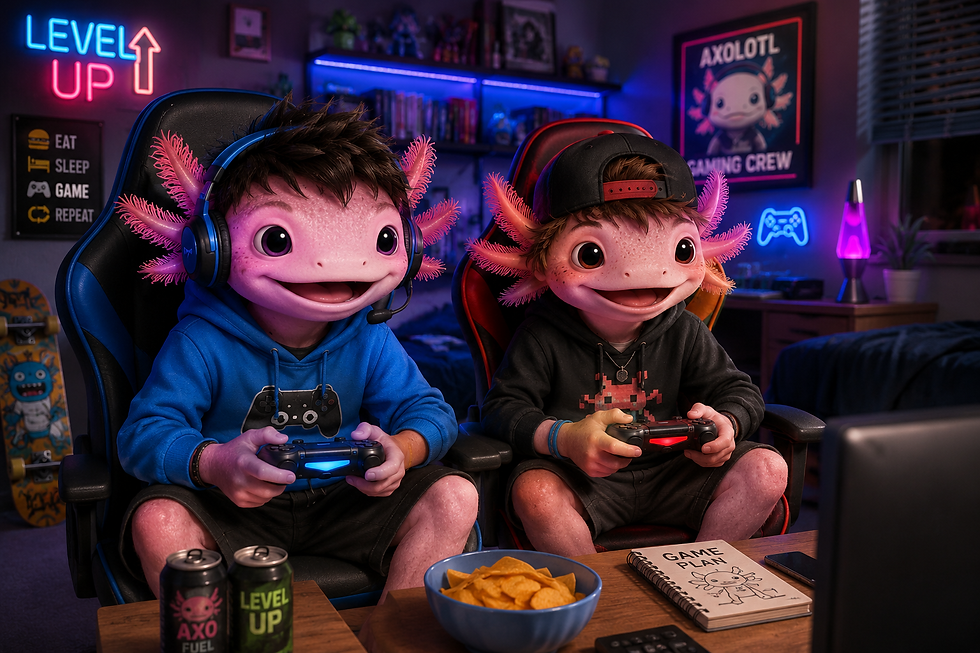
Meet Jake the Soccer Axolotl
Jake is a 10-year-old axolotl who loves soccer.
Every afternoon he practices with his friends.
When he scores a goal, his teammates cheer.
When he improves, he feels proud.
When he struggles, he learns resilience.
Soccer sends signals.
Those signals create a state.
That state shapes identity.
Identity drives behavior.
Behavior creates results.
The exact same thing happens in gaming.
The difference is that games often deliver those signals much faster.

The Kid Version of The Signal Loop™
What You See
The Game
The child sees:
Excitement
Competition
Teamwork
Challenges
Rewards
Progress
These are all signals.
What You Feel
The State
Those signals create feelings.
Research suggests video games can activate reward pathways associated with dopamine and motivation, especially during achievement, competition, and progression experiences (Koepp et al., 1998).
The child may feel:
Excited
Focused
Powerful
Connected
Important
Successful
This is their state.
What You Become
Identity
Repeated states become identity.
The child begins thinking:
"I am good at this."
"I belong here."
"I matter here."
"I win here."
Psychologists have long recognized that competence and mastery contribute to self-esteem and motivation (Ryan & Deci, 2000).
There is nothing inherently wrong with this.
The challenge occurs when most of the child's identity exists inside the game.
What You Do
Behavior
Identity drives behavior.
Children naturally move toward environments where they feel:
Competent
Accepted
Successful
Connected
This is why some children keep returning to games.
Not because they are lazy.
Because the game provides something psychologically meaningful.
What You Get
Results
Eventually results appear.
Positive results:
Enjoyment
Friendship
Teamwork
Recreation
Potential negative results:
Family conflict
Less physical activity
Reduced sleep
Isolation
Academic struggles
The result depends on whether gaming is part of life or replacing life.
Why The Anger Happens
Now let's return to the moment when the game ends.
Many parents see:
Game Off → Anger
But the actual process looks more like:
Game Off
↓
Signal Removed
↓
State Changes
↓
Identity Threatened
↓
Behavior Appears
The anger is often occurring because multiple psychological rewards disappeared simultaneously.
The child loses:
Progress
Competition
Social connection
Achievement
Excitement
Purpose
all at once.
Researchers studying problematic gaming have observed withdrawal-like symptoms including irritability, frustration, and mood changes when gaming is interrupted (King & Delfabbro, 2018).
That doesn't mean every child has Internet Gaming Disorder.
It means transitions can be difficult.
Especially when gaming has become the strongest source of stimulation in the child's day.
The Sports Axolotl Lesson
Imagine Jake the Soccer Axolotl scores the winning goal.
The crowd cheers.
His teammates celebrate.
He feels amazing.
Then practice ends.
Does Jake get angry?
Usually not.
Why?
Because soccer naturally contains transition.
The reward system ends gradually.
There is:
Walking off the field
Talking with teammates
Packing equipment
Driving home
Eating dinner
The nervous system has time to settle.
Gaming often ends instantly.
One second:
LEVEL COMPLETE
The next second:
Brush your teeth.
The transition is abrupt.
For some kids, that transition feels like slamming on the brakes at highway speed.
The Real Problem Isn't Gaming
The real problem is often imbalance.
A child needs multiple sources of reward.
Not just one.
The healthiest children typically build confidence from many places:
Sports
Family
Friendships
Hobbies
Creativity
School success
Outdoor adventures
Gaming
When gaming becomes the only reliable source of reward, emotions become more fragile.
What Parents Can Do
Instead of fighting the behavior, look upstream.
Look at the signals.
Ask:
What is gaming providing?
Is it:
Friendship?
Competence?
Excitement?
Escape?
Purpose?
Achievement?
The answer reveals what may be missing elsewhere.
The goal is not to eliminate gaming.
The goal is to build more sources of success.
The 67 Life Challenge™
This week ask your child:
"What is something that makes you feel as good as winning a game?"
If they struggle to answer, you've found an opportunity.
Help them discover:
A sport
A skill
A hobby
A challenge
A mission
Because the strongest identity is not built in one world.
It is built across many worlds.
Final Thought
Children rarely become angry because a screen turned off.
They become angry because a state changed.
The game was the signal.
The emotion was the state.
The state shaped identity.
Identity influenced behavior.
Behavior created the result.
When parents understand the Signal Loop™, they stop seeing children as problems to fix.
They start seeing children as systems to understand.
And understanding is where real change begins.
References
American Psychiatric Association. (2022). Diagnostic and Statistical Manual of Mental Disorders (DSM-5-TR).
King, D. L., & Delfabbro, P. H. (2018). The Concept of Withdrawal in Internet Gaming Disorder. Clinical Psychology Review, 64, 125-138.
Koepp, M. J., Gunn, R. N., Lawrence, A. D., et al. (1998). Evidence for Striatal Dopamine Release During a Video Game. Nature, 393, 266-268.
Ryan, R. M., & Deci, E. L. (2000). Self-Determination Theory and the Facilitation of Intrinsic Motivation, Social Development, and Well-Being. American Psychologist, 55(1), 68-78.
Twenge, J. M. (2024). The Anxious Generation.
World Health Organization. (2019). ICD-11 Gaming Disorder Criteria.

Comments